Wednesday, February 27, 2019

Yay, I'm someplace else

It feels so good to be on the road after a couple of months in essentially the same spot. It feels even better to be able to drive with the window open and camp without being sealed up against the chill and wind.

I’m in Ajo AZ. Tomorrow I’m going to talk to my mechanic, Ernie, about some work on the Rolling Steel Tent. After we chat I’ll be waiting for parts and a slot on his calendar, so I might be here a while, too. But it’s a change, and that’s good.

Tuesday, February 26, 2019

The downside

It looks like winter is fading here in southwest Arizona. Yay. However, that means some of the bugs are out and about. One of them had a nice meal on my inner arm last night. I hope I was tasty.

Sunday, February 24, 2019

Stick to the dark places

It was driving-with-the-window-open weather this afternoon in Yuma. Such a pleasant break from what we’d been having. Meanwhile, over half of Arizona is or was under snow. From Four Corners, to Grand Canyon, to Nogales and Douglas.

I don’t know the date of this satellite image. It’s from the past few days, though. It’s enough for me to plan my cold-avoiding travels.

Saturday, February 23, 2019

Destination or waypoint?

Some modern nomads like to find a spot and settle in for weeks at a time. I don’t mean the ones who need to stay put for some reason, like for a job or family, or because their fuel budget is small. I’m talking about those who choose to. It's as if they feel travel should consist of a lot of not traveling. I only semi-understand. Maybe I don’t understand at all.

And maybe I don’t understand why I always have the urge to move on, why I think of almost every destination as just the place before the next place.

Some observers say I’m running from something. Others suggest I’m chasing after something. Perhaps I just can’t get no satisfaction. But what would satisfy me? A free spot by a beautiful beach with perfect weather year round. At least for a while. And then...

I’ve spent most of three months in essentially the same spot near Yuma because my choices of desirable, livable, free camping places have been limited by severe weather in every direction. So I’ve proved I’m able to settle in for long periods. I just don’t enjoy it much.

It’ll become brutally hot here before very long and nomads will leave. Some will feel like they’re being driven out. I’ll be one of those who will feel like they’ve been freed from prison.

To rephrase Canned Heat: I’m so tired of staying/But I’m out on the road again/I’m on the road again. At least I will be. Soon.

Friday, February 22, 2019

Energy


I wonder if there’s a tiny reactor for the Rolling Steel Tent.

Wednesday, February 20, 2019

Warmth is on its way. Maybe.

If I can tough it out through the rest of the week (especially tomorrow) then I might be able to return to weather bliss. For a while, at least.The forecast is making no guesses about the week after.

Tuesday, February 19, 2019

Two birds with one stone

Lower temperatures and higher winds. It’s a good time to heat up the Rolling Steel Tent by making some pancakes.

Monday, February 18, 2019

Big clouds after some rain

A president for today

Today, 18 February 2019, is a slightly confusing holiday. Is it Washington’s Birthday? Washington’s and Lincoln’s two-fer birthday? President’s Day (singular possessive)? Presidents’ Day (plural possessive) that honors all presidents (except the awful ones)? The Uniform Holidays Act of 1968 says it’s the first one, but I’m going with the latter. And this year I’m singling out Theodore Roosevelt because of his commitment to preserving the nation’s natural beauty.
After becoming president in 1901, Roosevelt used his authority to establish 150 national forests, 51 federal bird reserves, four national game preserves, five national parks and 18 national monuments on over 230 million acres of public land.
Theodore Roosevelt and John Muir at Yosemite

He was serious about this conservation stuff. He said in a speech at the Grand Canyon:
I want to ask you to keep this great wonder of nature as it now is. I hope you will not have a building of any kind, not a summer cottage, a hotel or anything else, to mar the wonderful grandeur, the sublimity, the great loneliness and beauty of the canyon. Leave it as it is. You cannot improve on it. The ages have been at work on it, and man can only mar it. What you can do is to keep it for your children, your children’s children, and for all who come after you, as one of the great sights which every American if he can travel at all should see.
It didn’t work out quite that way, but his love and respect of the outdoors was passed on, with subsequent presidents creating more parks and preserves (well, until the current White House occupant).

Regarding Yellowstone National Park, he said:
The only way that the people as a whole can secure to themselves and their children the enjoyment in perpetuity of what the Yellowstone Park has to give is by assuming the ownership in the name of the nation and by jealously safeguarding and preserving the scenery, the forests, and the wild creatures.
Teddy was a conservative who actually believed in conserving, who believed government was part of the solution, not the primary problem. In yet another speech he said:
Conservation means development as much as it does protection. I recognize the right and duty of this generation to develop and use the natural resources of our land but I do not recognize the right to waste them, or to rob, by wasteful use, the generations that come after us. I ask nothing of the nation except that it so behave as each farmer here behaves with reference to his own children. That farmer is a poor creature who skins the land and leaves it worthless to his children. The farmer is a good farmer who, having enabled the land to support himself and to provide for the education of his children, leaves it to them a little better than he found it himself. I believe the same thing of a nation. 
Moreover, I believe that the natural resources must be used for the benefit of all our people, and not monopolized for the benefit of the few, and here again is another case in which I am accused of taking a revolutionary attitude. People forget now that one hundred years ago there were public men of good character who advocated the nation selling its public lands in great quantities, so that the nation could get the most money out of it, and giving it to the men who could cultivate it for their own uses. We took the proper democratic ground that the land should be granted in small sections to the men who were actually to till it and live on it. Now, with the water-power, with the forests, with the mines, we are brought face to face with the fact that there are many people who will go with us in conserving the resources only if they are to be allowed to exploit them for their benefit. That is the one of the fundamental reasons why the special interests should be driven out of politics. 
Of all the questions which can come before this nation, short of the actual preservation of its existence in a great war, there is none which compares in importance with the great central task of leaving this land even a better land for our descendants than it is for us, and training them into a better race to inhabit the land and pass it on. Conservation is a great moral issue, for it involves the patriotic duty of insuring the safety and continuance of the nation. Let me add that the health and vitality of our people are at least as well worth conserving as their forests, waters, lands, and minerals, and in this great work the national government must bear most important part.
Roosevelt’s commitment to conservation is one reason we have the Teddy Bear instead of the Teddy Corporate Greed Action Figure® with Land-raping Grip®.

Sunday, February 17, 2019

True


Where the people aren't

Where might you go in the United States if you want to get away from your fellow humans? This map can give you a hint. It was created from census data by Mapsbynik. The green areas are census blocks with no reported habitants.

Mapsbynik explains:
A Block is the smallest area unit used by the U.S. Census Bureau for tabulating statistics. As of the 2010 census, the United States consists of 11,078,300 Census Blocks. Of them, 4,871,270 blocks totaling 4.61 million square kilometers were reported to have no population living inside them. Despite having a population of more than 310 million people, 47 percent of the USA remains unoccupied.
Green shading indicates unoccupied Census Blocks. A single inhabitant is enough to omit a block from shading.
Not all of the green area is wilderness, though.
The map tends to highlight two types of areas: places where human habitation is physically restrictive or impossible, and places where human habitation is prohibited by social or legal convention.
Water features such lakes, rivers, swamps and floodplains are revealed as places where it is hard for people to live. In addition, the mountains and deserts of the West, with their hostility to human survival, remain largely void of permanent population.
Of the places where settlement is prohibited, the most apparent are wilderness protection and recreational areas (such as national and state parks) and military bases. At the national and regional scales, these places appear as large green tracts surrounded by otherwise populated countryside.
At the local level, city and county parks emerge in contrast to their developed urban and suburban surroundings. At this scale, even major roads such as highways and interstates stretch like ribbons across the landscape.
Commercial and industrial areas are also likely to be green on this map. The local shopping mall, an office park, a warehouse district or a factory may have their own Census Blocks. But if people don’t live there, they will be considered “uninhabited”. So it should be noted that just because a block is unoccupied, that does not mean it is undeveloped.
But, generally, it’s easier to find solitude in the western half of the country. Right now I'm in one of those green areas at the bottom edge of California.

Thursday, February 14, 2019

Not subject to my approval

Years ago, while my motorcycle buddies and I were taking a break on a weekend ride, another group of bikers rode by. That pack included a guy on a trike. I scoffed that he wasn’t a real motorcyclist. A friend replied, “Hey, at least he’s out riding. Besides, you don’t know, he might have a disability or something, in which case he should be commended.”

If you spend any time in online interest group forums—or real life groups, for that matter—you’ll encounter complaints that someone outside the group is doing your thing all wrong. Or (horror of horrors) the wrong people are doing your thing.

This attitude pops up in my community of full-time nomads. The following quote, referenced in a comment to one of my previous blog posts, is a good example tribal exclusionism mixed with I-was-into-it-before-it-was-cool hipsterism.
“For decades, nomadic living/van dwelling developed organically as people of modest means camped and traveled, while consciously rejecting bourgeois RVing. Now hordes of people without an intrinsic interest in outdoor travel have jumped on the bandwagon, and the humble nature of this life is quickly being corrupted. Hyper-materialistic/complex/convenience oriented builds, the rave party/festival atmosphere, and the lack of LNT ethics are symptomatic. I hope another shiny object emerges soon to draw these crowds away from nature.”
It’s funny how some folks who demand the freedom to live their own way can get bent out of shape by others living their own way. I plead guilty. I grumble about the wretched excess of huge RVs and mock the young, attractive, adventure-seeking, #vanlife people. But, hey, at least they’re out here enjoying the outdoors—in their own way.
After all, if you look the other direction down the Doing It Right scale, we modestly-equipped, motorized nomads are hyper-materialistic, convenience oriented, land defiling dilettantes to Edward Abbey types who believe only people like themselves should be allowed to enjoy the beauty of nature, on foot.

Sure, let’s all get righteously angry at those who are destructive and obnoxious. That’s a different issue.

Wednesday, February 13, 2019

The doctor will not see you now

What might a nomad such as myself do when a non-life-threatening-but-still-annoying ailment dares to intrude upon one’s idyllic existence? Your chances of having a local primary care physician are next to zero, and even if you had one you wouldn’t be able to book an appointment in the foreseeable future. A hospital emergency room is unnecessary, too expensive, a long wait, and a pile hassles. You have Medicare, though, because you’re an old fart.

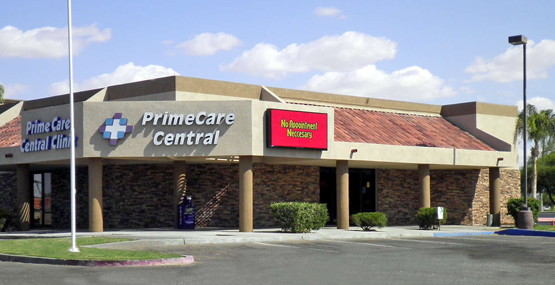
So you ask Google Maps to locate a walk-in clinic. Since Yuma is a good sized town, you’re informed there are three to choose from. In order to shorten your wait you arrive as the doors open, flash your Medicare card and ID, do a bit of paperwork and the next thing you know they’re weighing you and taking your blood pressure.

Urgent care facilities keep their prices down by using physician assistants and nurse practitioners instead of MDs. That’s fine for what I suspected ailed me: an infection in my throat and ears. If that turns out to be the case, and if they have the authority to prescribe antibiotics, I’ll be happy. Considering.

And, yay, the nurse practitioner confirmed my self-diagnosis and sent me on my way to the drug store for a week’s worth of Amoxicillin.

Afterward I thought, you know, the medical industry could use much more of this. So often you just need to see a trained person who can tell you whether you need to take matters to a higher, much more expensive, level. Sometimes all you require is stronger medication than you can get over the counter. Sometimes you just need someone to tell you it’s nothing serious. And sometimes you just want someone to shine a light in your mouth and say uvula.

Tuesday, February 12, 2019

This is how the nomad community can work

I came upon LaVonne on the side of the road to the 2014 Rubber Tramp Rendezvous. She had a flat tire. I stopped to see if she needed help but she said she’d already called AAA. When she got back to camp others took her to a tire shop for a replacement since her spare looked like it wouldn’t survive the trip there. I mounted her new tire to her van.

We vagabonds help each other.

Last week LaVonne was driving through open range at night when she hit a steer. Here are links to her story and the wonderful way it turned out.
PART 1 
PART 2
LaVonne calls it a miracle. I just call it good people caring about each other.

Monday, February 11, 2019

Too prepared?

In the early 1900s, Sir Ernest Shackleton led an expedition to Antarctica. His ship, the Endurance, became trapped in ice and broke apart. As he and his crew set out to reach a place they could be rescued, he directed the men to take only the barest necessities.

In his book about the doomed expedition, Alfred Lancing wrote, “From studying the outcome of past expeditions, [Shackleton] believed that those that burdened themselves with equipment to meet every contingency had fared much worse than those that had sacrificed total preparedness for speed.”

When we’re heading off on the nomadic life it makes sense to be prepared for every contingency. Or at least the most likely contingencies. But, as Shackleton understood, all that preparedness comes with tradeoffs.

Being well equipped can add day-to-day complications. For example, the more you put in your rig, the more it weighs, the more fuel it burns, and the less room there is for yourself.

They say it’s better to have it and not need it than to need it and not have it. But backpackers say, “Remember, you have to carry all that shit.” Carrying heavy loads builds muscle but punishes joints and feet.

Each person needs to find their personal balance. What are your priorities? What are your abilities? What are you willing to do without? What best fits the way you go about the whole vehicle living thing? What is required for your safety, your peace of mind? For happiness?